

Up to 70% off eSIMs - APP only


Flag Day trail: 7 places where Albanian history was made
By GjirafaTravel ·
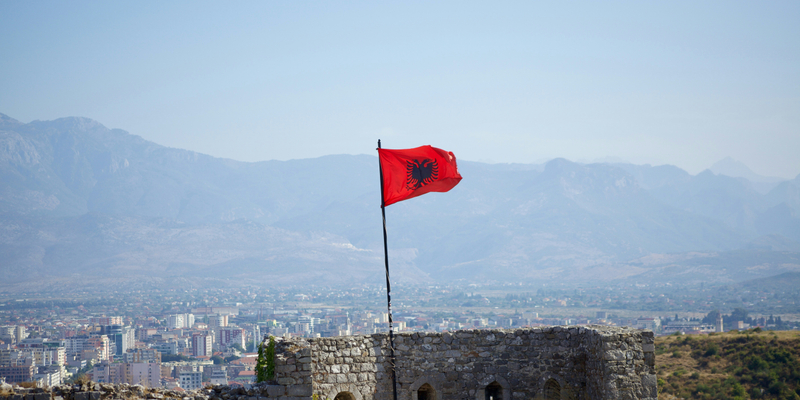
Look out of any window today, in Tirana, Prishtina, Tetovo or a street in Zürich, and you'll see it: red cloth and a black eagle with two heads, moving in the November wind. But that flag didn't reach your balcony in one day. It was raised on a castle, forgotten for centuries, carried into meeting rooms and argued over in old houses across three countries, and every one of those places is still standing. Here is the trail it took, seven stops and almost 600 years, and what you'll find when you stand there yourself.
Red, black and two heads: the story behind our flag
The flag is older than the country. It began as a family sign. Gjergj Kastrioti, the man the world calls Skanderbeg, used a black double-headed eagle on a red background as his family's banner. On 28 November 1443 he raised it over the castle of Krujë, and for 25 years it flew over one of the toughest fights the Ottoman Empire faced in the Balkans.
After Skanderbeg died in 1468, the flag went quiet for a very long time. It came back at the end of the 1800s, mostly thanks to Albanians living abroad. Writers like Faik Konica in Brussels and Qerim Panariti in Boston brought Skanderbeg's story and his eagle back to life and turned them into something every Albanian, at home or far away, could stand behind.
Then came 28 November 1912. In Vlorë, Ismail Qemali raised the same red and black flag and Albania was declared independent, on the very same date as Skanderbeg's flag in 1443. That's why today is called both Independence Day and Flag Day.
A few more things worth knowing before you set off:
- The eagle. Albanians call themselves shqiptarë and their country Shqipëri. Many of us grew up hearing that the words come from shqiponjë, the eagle, which makes us "the sons of the eagle". Historians argue about it, but you won't find an Albanian who doesn't love the idea.
- The anthem is about the flag. Our national anthem is called "Himni i Flamurit", the Hymn to the Flag. It was first a poem by Asdreni, a poet born in the village of Drenovë near Korçë, published in 1912 and set to music by the Romanian composer Ciprian Porumbescu. Its first line says it all: "Rreth flamurit të përbashkuar" (Around the flag, we stand united).
- The flag you see today is "new" again. During communism a star sat above the eagle. In 1992 it was taken off, and the flag went back to the simple design Skanderbeg would recognise: just the black eagle on red.
The trail of the flag: 7 stops, from 1443 to 1912
Here's the trick that makes this trail so special: the same names keep showing up. A man who helps start something in one town turns up years later at the next turning point in another. Keep an eye out for them as you read.
1443, Krujë: the day the eagle went up the wall
In November 1443, the Ottoman army lost a big battle at Niš, in today's Serbia. Skanderbeg, who had grown up and served in that army, chose that moment to leave it. He rode home with a small group of men, took Krujë with a forged letter, and on 28 November raised his family's flag over the castle. Krujë then held out against three big Ottoman sieges while he was alive.
Today, the castle is home to the Skanderbeg Museum, which opened on 1 November 1982 and looks like a fortress inside a fortress. Go in knowing one small secret: Skanderbeg's real helmet and sword are kept in Vienna, so what you see here are copies. That makes the museum's real treasure the story itself, told room by room, from the boy taken from his family to the man who came back to raise the flag.
Before you go inside, look up. The red and black flag flies from the top of the museum, on the same hill where Skanderbeg raised it. Krujë sits on a mountainside about 35 km north of Tirana, and from the castle walls you look out over the wide plain below.
1878, Prizren: the summer Albanians spoke with one voice
On 10 June 1878, more than 300 delegates from all over the Albanian lands met in a simple building by the river in Prizren. The big powers of Europe were about to hand Albanian land to neighbouring states. The delegates formed the League of Prizren to stop it, and under the lead of Abdyl Frashëri they sent a memorandum to the Congress of Berlin asking for all Albanians to be joined in one province.
Europe didn't listen. Germany's Bismarck is said to have answered that there was no such thing as an Albanian nation. The League was crushed by 1881, but the idea it started never went away.
The building has its own story. On 27 March 1999, during the Kosovo war, Serbian forces burned it down. By June 2000 it had been rebuilt, and today it's a small museum full of documents, old weapons and portraits from those years. One tip: very little inside is written in English, so if you don't read Albanian, read about the League before you go or bring a friend who does. It makes the room come alive.
Our buses leave Prishtina for Prizren eight times a day, so the 83 km ride is the easy part.
1887, Korçë: a school in our own language, at last
Under Ottoman rule, teaching in Albanian was something people did in private, often in secret. On 7 March 1887, that changed in Korçë, when the first Albanian school, the Mësonjëtorja, opened its doors in a house given by a local patriot, Diamanti Terpo. Its first teacher was Pandeli Sotiri, and the books were written by Sami and Naim Frashëri, the brothers of Abdyl, the man who led the League of Prizren.
Remember Pandeli Sotiri? He's one of the names that keeps coming back: he was also one of the key people of the League of Prizren nine years earlier.
It wasn't the very first place Albanian was ever taught (Franciscan schools in Shkodër taught it earlier), but the Mësonjëtorja became the symbol of Albanian education. That's why 7 March is Teachers' Day for Albanians everywhere. The house is now the National Museum of Education, and here's what most visitors miss: look for the older Albanian alphabets on display, made by Naum Veqilharxhi and Kostandin Kristoforidhi. Each writer used to have his own way of writing our language. Hold that thought until stop five.
1899, Peja: a pledge in the shadow of the mountains
In January 1899, about 450 Albanians from across Kosovo met in Peja and gave each other their besa, the Albanian word of honour. They formed the League of Peja, also called Besa-Besë, to defend Albanian lands once again. Their leader was Haxhi Zeka, who had been a member of the League of Prizren 21 years before. The Ottoman army broke up the League in 1900, and Zeka was killed in 1902.
You can still follow him through the town. Start at Haxhi Zeka Square in the centre, where his statue stands near a fountain from the 1500s. The Peja Museum is on the same square, in an old 18th-century house (open 08:30 to 15:30 on weekdays), and it's a good place to warm up on a cold day. From there, walk into the old bazaar to his grave, in front of the Bajrakli Mosque, and look for his kulla, the stone tower house that carries his name.
Four or five of our buses a day make the trip from Prishtina to Peja, around 80 km west.
1908, Manastir: the week we chose our alphabet
This is the stop that explains why you can read Albanian on your phone today. Before 1908, Albanian was written with six or more different alphabets, depending on where you lived and what faith you followed. From 14 to 22 November 1908, about 50 delegates from 26 cities and clubs met in Manastir (today's Bitola, in North Macedonia) to settle it once and for all.
The meeting took place in the house of Fehim Zavalani, home of the Bashkimi (Unity) club. Look at who was in the room: a commission of Catholics, Orthodox, Protestants and Muslims, led by Gjergj Fishta, a Franciscan priest from the Shkodër region, who said he hadn't come to defend any one alphabet but to unite with the others behind whichever the Congress chose. The Congress itself was chaired by Mid'hat Frashëri, son of Abdyl Frashëri of the League of Prizren. Its secretary was a young man from Shkodër called Luigj Gurakuqi. Remember him.
They chose a Latin-based alphabet, the one with 36 letters you use today, and 22 November has been Alphabet Day ever since. The house, by the Dragor river, opened as the Museum of the Albanian Alphabet on 22 November 2012. Inside are wax figures of the delegates, and dozens of photographs and hundreds of documents from those days. Look for the faces of Fishta, Frashëri and Gurakuqi among the photographs. It's a small moment, but a strong one.
1909, Elbasan: training the teachers of a nation
An alphabet means nothing without teachers to teach it. So in September 1909, a congress in Elbasan decided to open a school to train them. On 1 December 1909, the Normal School of Elbasan (Shkolla Normale) opened its doors, the first Albanian secondary school of its kind. Its first director? Luigj Gurakuqi, the secretary from Manastir. The money came from the Përparimi society of Korçë, and students came from every Albanian land, many of them from Kosovo.
The school is still alive, and today it carries Luigj Gurakuqi's name. People still call it "Normalja", and for many years it was led by the language scholar Aleksandër Xhuvani. Its museum keeps the most important documents and objects from those first years. If you can, go on 1 December: the school celebrates its birthday, and this year it turns 117.
One of our buses leaves Prishtina for Elbasan early every morning, a long ride of nearly 300 km.
1912, Vlorë: the flag goes up for good
Everything on this trail leads here. In the summer of 1912, Albanians in Kosovo rose up: in May their leaders gave a besa in Junik, and by August the rebels had taken Prishtina and then Skopje. That autumn, with the Balkan Wars breaking out all around, Ismail Qemali reached Vlorë. On 28 November 1912, delegates from all over the Albanian lands declared Albania free and independent, and Qemali raised the flag. The declaration was written by Qemali and Luigj Gurakuqi, our young secretary from Manastir and director from Elbasan, now signing the birth of a country.
Two surprising details. First, there's no known photograph of the flag going up on that day: the famous picture in history books was taken at the first anniversary, in 1913. Second, the anthem sung that day was learned first by a choir from Korçë, who brought Asdreni's Hymn to the Flag to Vlorë.
Today you can walk into the very building where independence was declared, now the National Museum of Independence. Outside, Flag Square (Sheshi i Flamurit) has the 17-metre Independence Monument, with Ismail Qemali at its centre, and his grave is on the same square. This is where the state ceremony happens every 28 November.
More than ten of our buses a day leave Tirana for Vlorë, about 150 km south, and you'll find every bus in and out of town on our Vlorë page.
Flag Day today, wherever Albanians live
In Albania, 28 November is a public holiday, and it's followed straight away by 29 November, Liberation Day. This year the 28th falls on a Saturday, so Monday the 30th is a day off too. The main ceremony is in Flag Square in Vlorë, with the country's leaders, the anthem and flowers at Qemali's grave.
In Kosovo, the government declared 28 November a holiday in 2017, calling it "the day of Albanians". Even before that, people celebrated it as their own. For Kosovo, November carries extra weight: President Vjosa Osmani has called Flag Day, Albania's independence, the birth of Adem Jashari and the first public appearance of the KLA the four November events at the heart of national pride.
In North Macedonia, the date isn't on the official list of public holidays, but in Albanian towns and neighbourhoods you'll see the flag on balconies, cars and shop windows, with concerts and gatherings all day.
And in the diaspora, from Germany and Switzerland to the United States, the day is marked with flags, music and long dinners. In a way, that brings the story full circle: the flag came back to life in the 1800s thanks to Albanians abroad.
Following the trail yourself
You don't need to see all seven stops in one trip. Pick two or three and give each one time. Vlorë, Prizren, Peja and Elbasan are all on our routes, so you can plan those around the buses above, and our digital tickets work with Apple Wallet, so the only thing you need to keep an eye on is the view. Krujë, Korçë and Manastir aren't on our routes yet, but they're worth planning for on their own.
A few small tips that make a big difference:
- Read a little before you go. Several of these museums have few signs in English. Ten minutes of reading turns an old room into a story.
- Look for the dates. 7 March in Korçë, 10 June in Prizren, 22 November in Manastir, 1 December in Elbasan and 28 November in Vlorë and Krujë. On those days the places are full of life.
- Follow the names. Frashëri, Sotiri, Zeka, Fishta, Gurakuqi, Qemali. Once you start spotting them, every stop feels like the next chapter of the same book.
FAQs
Why is Flag Day on 28 November?
Because two of the most important moments in Albanian history happened on that date. On 28 November 1443, Skanderbeg raised his red and black flag over Krujë. On 28 November 1912, Ismail Qemali raised the same flag in Vlorë and Albania was declared independent.
Is Flag Day the same as Albanian Independence Day?
Yes. In Albania the holiday is officially called Flag and Independence Day. Don't mix it up with 29 November, which is Liberation Day and marks the end of World War II in Albania.
Is 28 November a holiday in Kosovo and North Macedonia?
In Kosovo, the government declared it a holiday in 2017 as "the day of Albanians". In North Macedonia it isn't an official public holiday, but Albanians there celebrate it widely.
What do the red colour and the double-headed eagle mean?
The design comes from the family banner of Skanderbeg, who raised it in 1443. Many Albanians also link the eagle to the name of the country, Shqipëri, and the word for eagle, shqiponjë, though historians still debate that link.
Who wrote the Albanian national anthem?
The words of "Himni i Flamurit" (Hymn to the Flag) were written in 1912 by the poet Asdreni, who was born near Korçë. The music comes from the Romanian composer Ciprian Porumbescu.
Can I visit the building where independence was declared?
Yes. It's now the National Museum of Independence in Vlorë, close to Flag Square, where the Independence Monument and Ismail Qemali's grave stand.
Do I need a printed bus ticket for these trips?
No. You get a digital ticket, and if you travel with an iPhone it can sit in Apple Wallet, easy to find even without internet.
Stay connected
Now you know where to go, what to eat and what to skip. But what happens when you need a map, the next bus or a quick call home? Our eSIM for Albania, Kosovo or North Macedonia keeps you online from day one, so you never have to search for Wi-Fi. Since you read this far, you get a little extra: type BLOG10 when you buy it. Which place will you visit first?